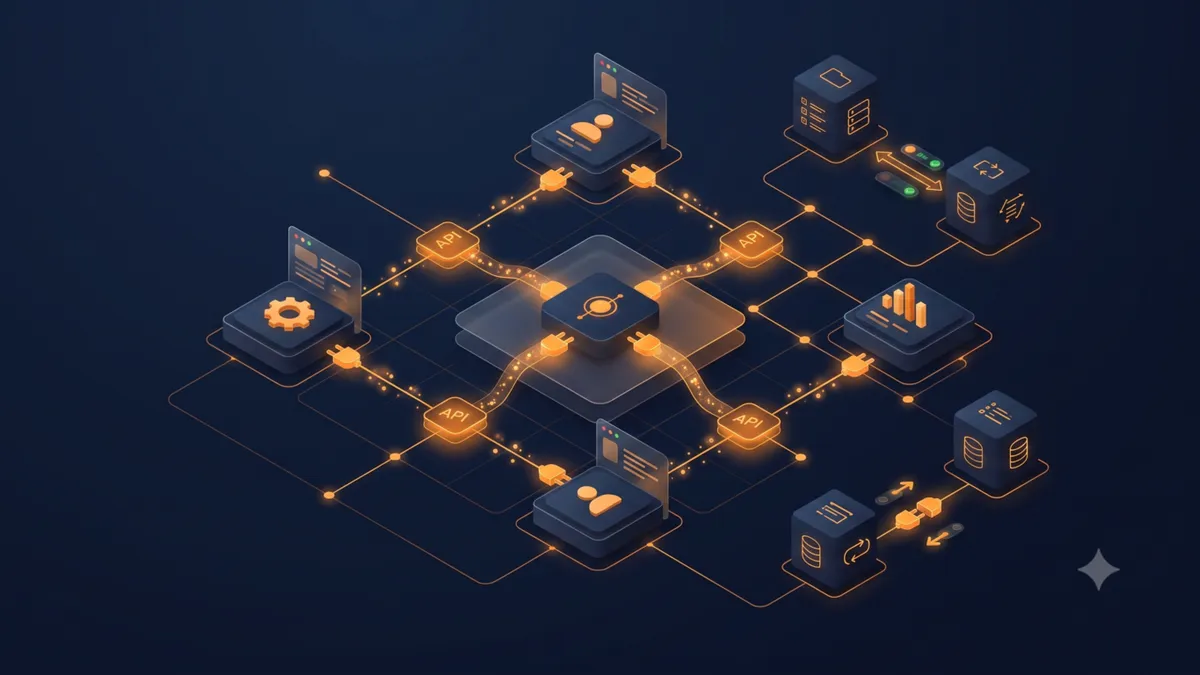
Somewhere in most organizations, someone’s job includes copying the same piece of information from one system into another, by hand, because the two were never built to talk to each other. That’s rarely a case for ripping either system out — it’s a case for the connection between them getting the same engineering attention as the systems themselves. We build integrations to be boring in the best sense: predictable, observable, and documented well enough that the next person doesn’t have to reverse-engineer what happens when something breaks.
Service
Integration Services
Connecting the systems you already have instead of forcing a rebuild.
Overview
Challenges
Business challenges we solve
Data trapped in disconnected systems
The same customer, order, or record exists in three places and none of them agree.
Manual re-entry between tools that should talk to each other
Someone's job is quietly copying data from one system into another, by hand, every day.
A patchwork of point-to-point integrations nobody fully understands
Every new connection was bolted on under deadline pressure, and now nobody knows what breaks what.
Capabilities
Our capabilities
API design & development
Clean, documented interfaces designed so the next integration is easier to build than the last one.
Third-party & legacy system integration
Connecting modern platforms to systems that were never built to talk to anything — payment gateways, POS systems, legacy databases.
Data pipeline & sync architecture
Reliable, observable data flow between systems, with a clear answer for what happens when something fails.
Approach
Our delivery approach
Stack
Technologies & platforms
Integration
Middleware
Databases
Engagement
Engagement models
Fixed scope
Defined project
A specific system-to-system integration, scoped and priced up front.
Best for a specific system-to-system integrationTime & material
Flexible scope
Integration work billed against actual effort as new needs surface.
Best for an evolving integration landscapeDedicated team
Embedded capacity
A team embedded in your integration architecture over time.
Best for ongoing integration architecture ownership
FAQ
Frequently asked questions
Not usually — most integration work connects what you already have rather than replacing it. Replacement only comes up when a system genuinely can't support what's being asked of it.
It's designed for from the start: retries, dead-letter handling, and alerting so a failure gets caught and fixed instead of disappearing silently.
Yes — auditing and documenting an undocumented integration landscape is often the first, most valuable step before adding anything new to it.